Product Launch Case Study
From an idea to a production business.
Tailendar became a practical exercise in product development, cloud operations, AI-assisted content production, governance, business formation and go-to-market execution.
In 2026, I took Tailendar from an initial idea through development and commercial release. Tailendar Cats & Dogs 2027 launched on Google Play in October 2026.
The Idea
Simple for the customer. Substantial behind the scenes.
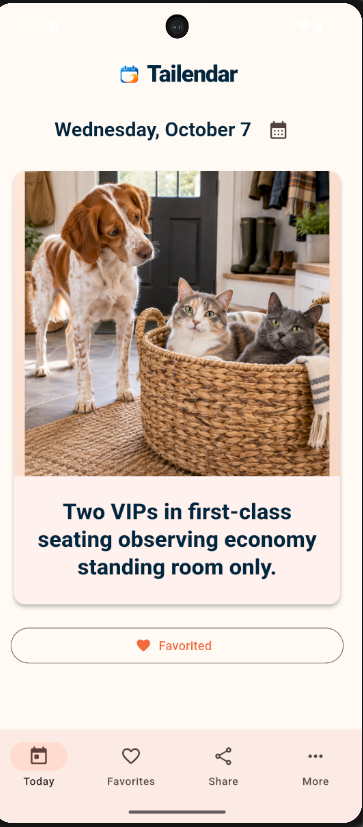
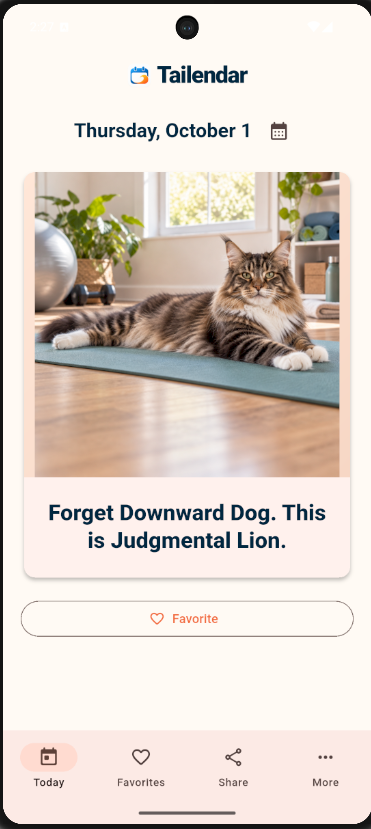
The customer proposition is intentionally straightforward: choose Dogs, Cats or Both and get a new pet moment every day. The 2027 edition contains 1,095 daily experiences—365 for each choice.
The product also uses a deliberately simple commercial model: $7.99 once for the entire year, with no subscription or recurring charge.
Delivering that simple experience required decisions across product design, content, technology, operations, quality, compliance and marketing.
Building the Product
Design for repeatable operation, not just launch day.
Tailendar was built as a Flutter application with cloud-delivered content, allowing the application experience and the daily content operation to be managed as related but distinct capabilities.
The work included application development, content-delivery architecture, testing, release management, marketplace preparation and production verification. The operating model had to support a full year of content without turning every update into an application release.

AI in Production
Acceleration still needs controls.
AI assisted both development and content production, but generation alone was never treated as production readiness. Repeated concepts, visual continuity, object-state errors and inconsistent outputs required a more disciplined approach.
I developed production standards, validation controls, repetition checks, documented workflows and human review gates around the AI-supported process. Probabilistic tools can accelerate production, but reliable outcomes still require governance and verification.
Building the Business
A product launch is also an operating model.
Moving from project to commercial product required work beyond the application itself. The technical solution is only one part of a viable service; ownership, risk, support, financial decisions and customer experience have to work with it.
Going to Market
Shipping changes the nature of the work.
Commercial release required marketplace compliance, production testing, launch communications, website and social channels, customer support planning and a measurable launch baseline.
The launch begins the next operating cycle: measuring adoption, learning from customer behavior, maintaining the content service and extending the product to additional platforms.
The Leadership Connection
The product is small. The operating disciplines aren't.
Product strategy, cloud operations, AI governance, quality assurance, security, business operations and go-to-market execution all had to work together to get from an idea to a customer-ready product. Those are the same disciplines that matter in larger technology environments: connect technology to an outcome, design for operations, manage risk, establish governance and keep the customer experience visible throughout.