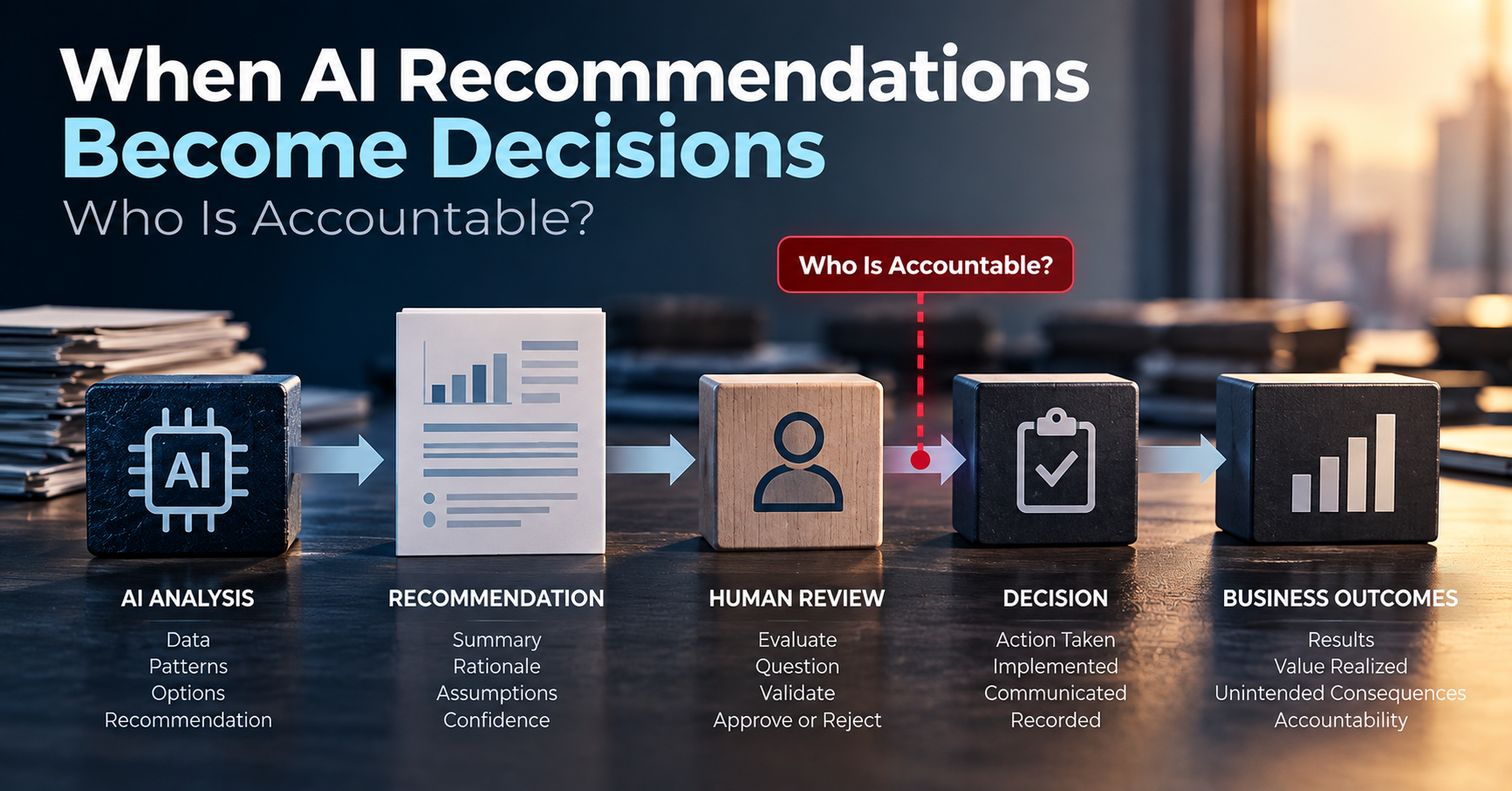
Artificial intelligence is becoming part of everyday business operations.
It can evaluate information, identify patterns, prioritize activities, and recommend actions faster than many traditional processes.
Those capabilities create considerable opportunities.
But they also introduce a question that I believe deserves more attention.
At what point does an AI recommendation effectively become a business decision?
The distinction may seem obvious. AI recommends. People decide.
But I'm not convinced the separation is always that clear in practice.
As organizations become more comfortable with AI-generated recommendations, there is a risk that reviewing those recommendations becomes a routine approval step rather than an exercise in judgment.
And when that happens, the organization may be delegating more decision-making authority than it realizes.
The Recommendation That Nobody Questioned
Consider an AI-supported service management platform.
It reviews an incident, examines the available information, and recommends closing the ticket.
The technical indicators suggest the service is operating normally. The automated checks have passed, and the original alert has cleared.
The recommendation appears reasonable.
But what if the underlying business problem remains unresolved?
Perhaps the application is available, but an important business function is still failing. The technical issue has cleared, yet employees cannot complete the work the service is intended to support.
Someone reviews the recommendation, sees the supporting technical indicators, and approves closure.
The system records a successful resolution.
From a process perspective, everything may appear to have worked correctly.
From the business perspective, the problem still exists.
This is a familiar distinction in IT service management. Restoring a technical component is not necessarily the same as restoring the service the business depends on.
AI doesn't create that problem. But it can make the process faster and more consistent, including when the underlying assumptions are incomplete.
The concern isn't simply whether the recommendation was technically reasonable. It's whether anyone was accountable for validating the business outcome.
When Review Becomes Approval
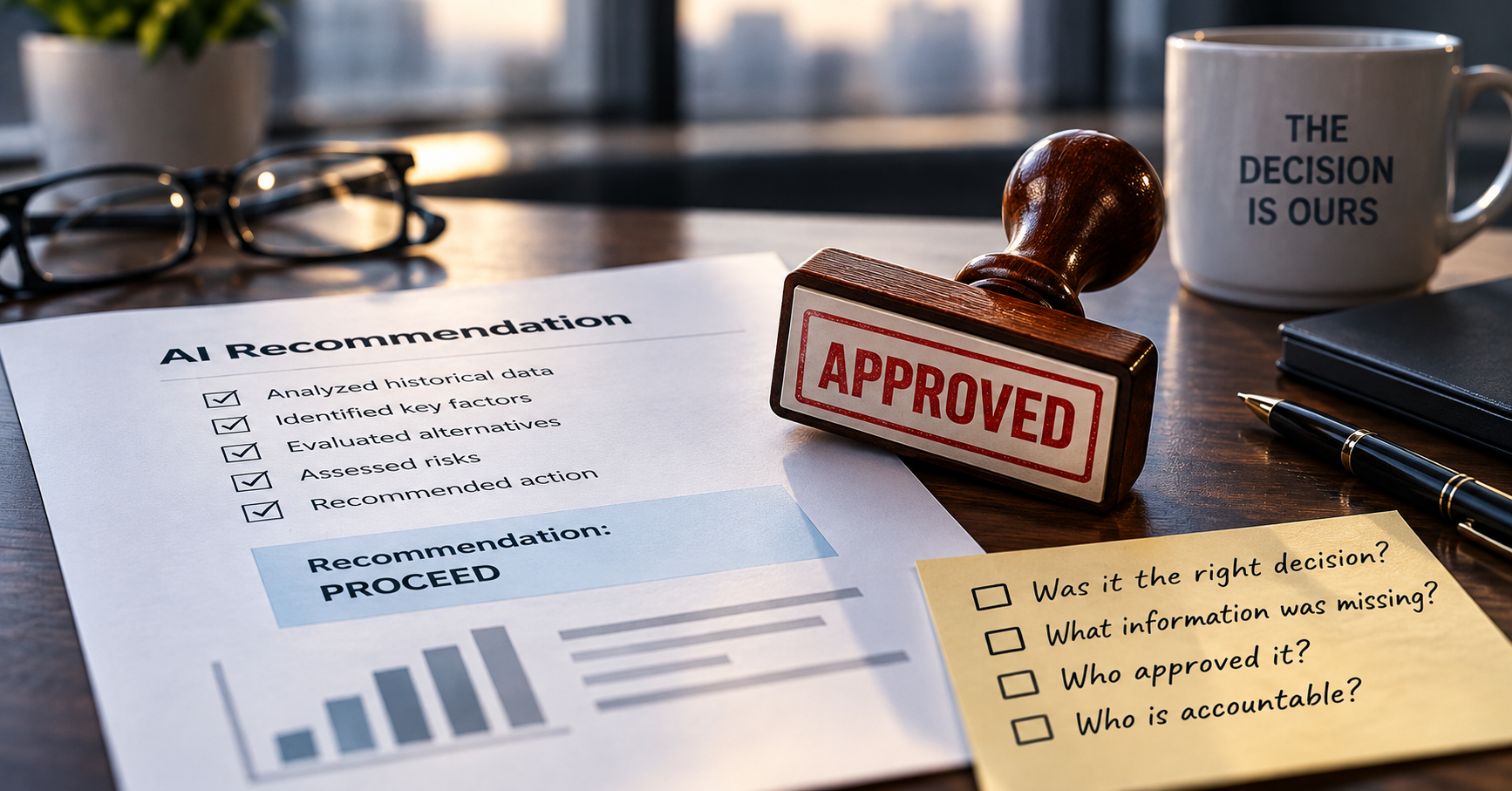
Organizations often describe human oversight as a safeguard against inappropriate AI decisions.
That's reasonable, but it raises another question.
What does that oversight actually involve?
If an employee receives an AI recommendation, reviews a summary, and clicks Approve, has meaningful oversight occurred?
Possibly.
But what if the employee doesn't understand the assumptions behind the recommendation?
What if the supporting information is incomplete?
What if the person reviewing the recommendation lacks the authority to challenge it, or the time to investigate?
And what if the organization's performance expectations encourage employees to process recommendations quickly rather than question them?
In those circumstances, the human approval may provide little protection.
The organization has retained a person in the workflow, but that doesn't necessarily mean it has retained independent judgment.
Human oversight is not defined by the presence of a person. It's defined by that person's ability and responsibility to evaluate the decision.
That distinction matters as AI becomes increasingly integrated into operational processes.
The Quiet Transfer of Authority
Decision-making authority doesn't always move through a formal delegation.
Sometimes it shifts gradually through everyday practices.
A system begins by providing information.
Then it recommends actions.
Over time, those recommendations become trusted because they are generally accurate and save considerable effort.
Eventually, employees begin accepting them unless something appears obviously wrong.
At that point, the recommendation may have become the default decision.
No formal policy changed. No executive explicitly delegated additional authority.
But operational behavior changed.
This is particularly important in environments where employees are managing high volumes of work.
Consider an AI-supported hiring process.
The system evaluates applications and recommends which candidates should advance.
A recruiter reviews the shortlist and moves forward with the recommended candidates.
But what happens to the applicants who never reached the shortlist?
Was someone responsible for evaluating the screening criteria and determining whether qualified candidates were being excluded?
Or was the recommendation effectively accepted before a person became involved?
The same concern can apply to cybersecurity prioritization, financial exception handling, customer service, and resource allocation.
The issue is not whether AI should be allowed to make recommendations.
It's whether the organization understands when those recommendations begin determining outcomes.
Accountability Cannot Be Delegated to an Algorithm
Technology leaders have dealt with similar questions for years.
Automated monitoring can detect failures. Workflow systems can route approvals. Security platforms can block activity. Service management tools can enforce operational processes.
Automation is not new.
Neither is the need for accountability.
What is changing is the complexity of the recommendations and the speed at which they can influence decisions.
When an AI-supported process produces an undesirable outcome, saying that the system recommended the action is not an adequate explanation.
Someone must still be responsible for the process, the controls, and the consequences.
That doesn't mean every decision requires executive involvement.
It means authority and accountability should be established before the technology is allowed to influence consequential outcomes.
Who owns the process?
Who determines which decisions may be automated?
Who validates the criteria being used?
Who monitors whether the expected business outcomes are being achieved?
And who has the authority to intervene when the system produces an inappropriate recommendation?
These are management responsibilities.
They don't disappear because the underlying technology becomes more sophisticated.
Not Every Decision Requires the Same Oversight
I don't believe the solution is to place multiple layers of approval around every AI-assisted activity.
That would undermine much of the value organizations hope to achieve.
The appropriate level of oversight should reflect the consequences of an incorrect decision.
This is familiar territory in technology operations.
In change management, we don't necessarily apply the same controls to a routine, well-understood change that we apply to a major change affecting critical business services.
We consider risk, impact, dependencies, and the ability to recover.
AI-supported decisions deserve similar consideration.
A low-risk activity with predictable results may be appropriate for substantial automation.
A decision affecting employment, significant financial commitments, sensitive information, or critical business operations requires a different level of scrutiny.
The important question is not simply whether AI is involved.
It's what authority the system is exercising, directly or indirectly, and what happens if the result is wrong.
Governance should follow the consequences of the decision, not simply the sophistication of the technology.
The Difference Between Process Compliance and Business Results
One concern I have with increasing automation is the temptation to measure success primarily through process efficiency.
How many recommendations were processed?
How many decisions were automated?
How much time was saved?
How quickly were requests completed?
Those metrics have value.
But they can also create a misleading picture.
Returning to the service management example, an organization might report improved resolution times and fewer open incidents.
Those numbers look encouraging.
But if employees are reopening tickets, developing workarounds, or experiencing recurring business disruptions, what has actually improved?
The process may be operating more efficiently without delivering better service.
This is why I've consistently believed that technology performance must be connected to business outcomes.
The same principle applies to AI.
A recommendation can satisfy the defined criteria and still produce an undesirable result.
An automated workflow can operate exactly as designed and still fail to meet the business need.
The objective should not be to maximize the number of decisions made by AI.
It should be to improve the quality, consistency, and effectiveness of organizational decisions.
What Leaders Should Be Asking
As organizations expand AI adoption, I believe leadership discussions need to move beyond which tools are being deployed and how much productivity they generate.
We should also be asking:
Where is AI influencing decisions today?
Not just where it is formally authorized to make decisions, but where employees routinely accept its recommendations.
Which decisions have meaningful consequences?
Identify where an incorrect recommendation could affect people, financial results, security, service delivery, or organizational reputation.
What does human oversight actually require?
Define the information, authority, and responsibility necessary for someone to challenge or reject a recommendation.
How do we know the process is producing the intended outcome?
Measure business results, not simply processing speed or compliance with workflow steps.
What happens when the recommendation is wrong?
Establish clear escalation, correction, and accountability before a failure occurs.
These questions don't require organizations to abandon automation or slow every decision.
They require organizations to understand how authority is being exercised.
From Analysis to Accountability
In an earlier article, Discovery Before Creation, I discussed the importance of using AI to understand a problem before rushing to produce a solution.
That principle remains important.
AI can help identify patterns, examine alternatives, and challenge assumptions.
But once those analytical capabilities become embedded in operational workflows, another responsibility emerges.
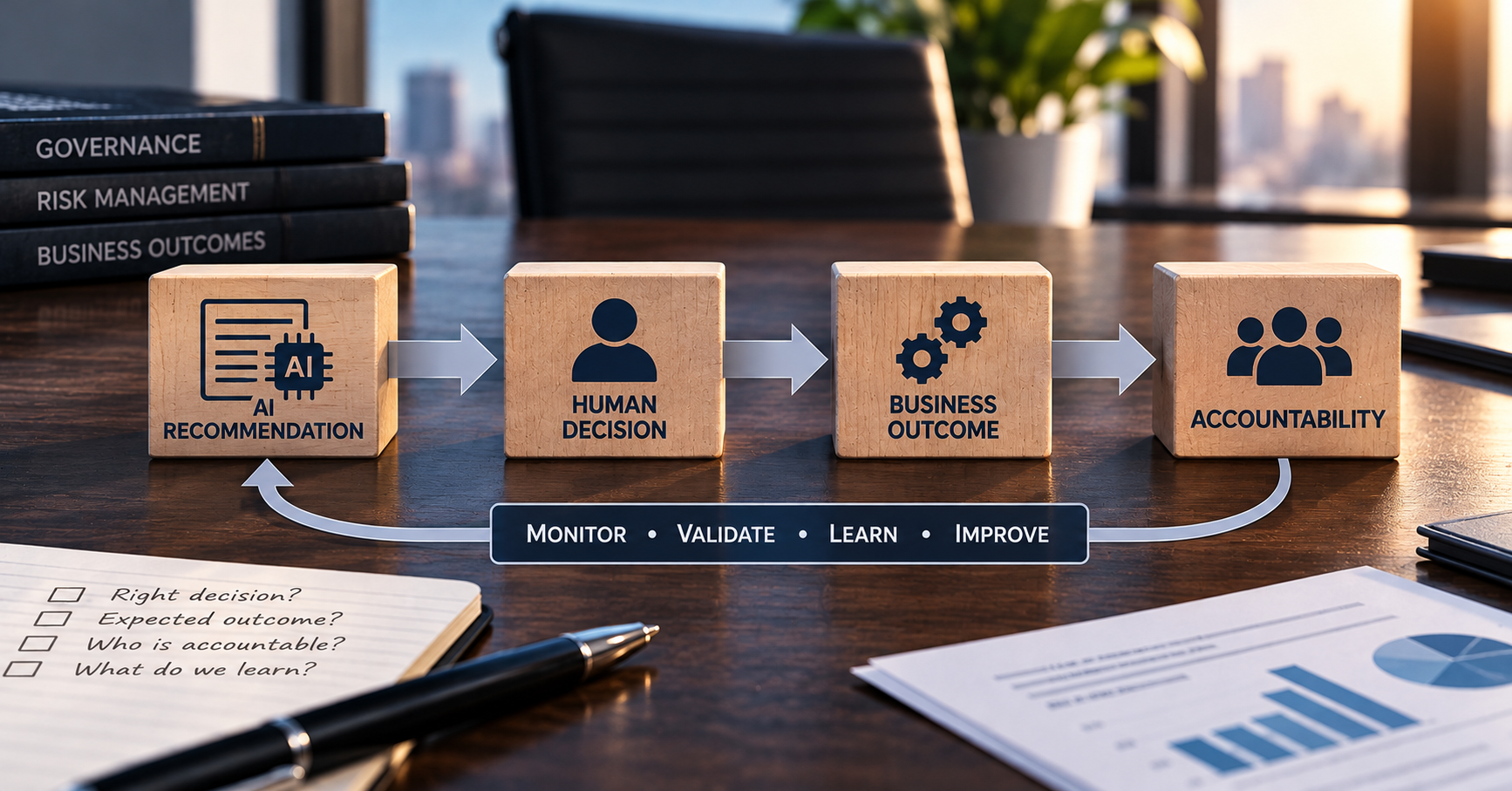
Organizations must understand how recommendations translate into actions and who is accountable for the results.
The distinction is important.
Analysis helps inform a decision.
Authority determines whether that decision is acted upon.
Accountability establishes who is responsible for the outcome.
AI can support all three activities, but it should not obscure where organizational responsibility resides.
I see tremendous potential for AI to improve business operations.
But realizing that potential requires more than deploying capable tools and measuring productivity.
It requires leadership discipline.
The question is no longer simply whether AI can make a recommendation.
It's whether the organization understands who is actually making the decision.
And whether that person or that organization is prepared to be accountable for what happens next.
A question for technology and business leaders:
If an AI-supported decision produces the wrong outcome, can your organization explain who had the authority to approve it, what evidence supported it, and who is accountable for the result?