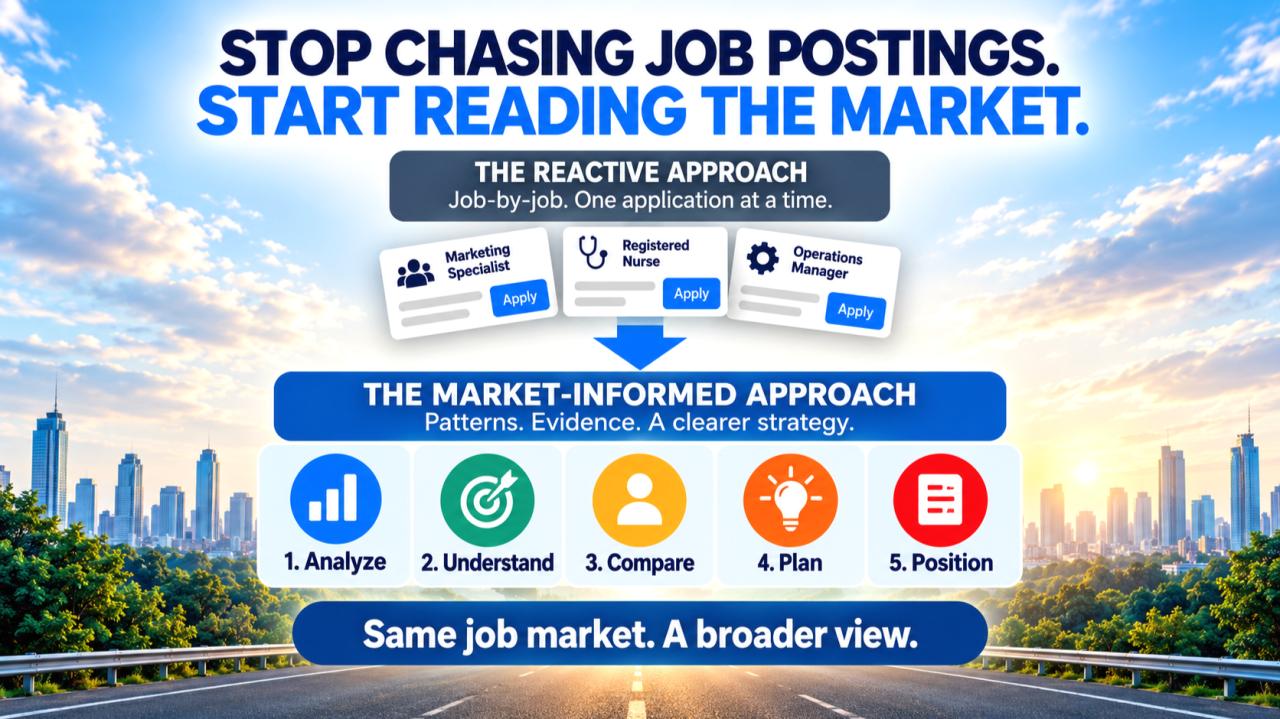
Most job searches are built around individual opportunities.
You find a posting. You read the requirements. You decide whether you are a fit. You adjust your resume. You apply.
Then you do it again.
Those individual signals can be useful. But they leave a different question unanswered:
Instead of treating every posting as an isolated opportunity, we can use AI to examine a larger collection of current postings, identify recurring patterns, compare those patterns with our actual experience, decide what—if anything—we should do about the gaps, and position ourselves accordingly.
This isn't about teaching AI to game the hiring process. It's about using AI to replace assumptions with evidence.
One Job Is an Opportunity. Many Jobs Become Data.
One job posting can tell you what one employer wants. Fifty can begin to tell you what a market wants. Seventy-five or one hundred can reveal patterns that are difficult to see when we're moving from application to application.
Which capabilities appear repeatedly? Which technologies, tools, credentials, or experience requirements keep showing up? Which requirements are usually required, and which are merely preferred? Do those patterns change by seniority, industry, geography, or work arrangement?
At that point, you're no longer simply reading job descriptions. You're reading a market.
Don't simply ask AI, “What skills are employers looking for in my field?” That invites an answer from existing knowledge, assumptions or generalizations. Instead, give the AI the evidence and ask it to analyze the evidence.
1. Analyze
Find the patterns across current job postings.
Start by defining the market you actually want to understand: role, career level, geography, work arrangement and any industry constraints that genuinely matter. Then gather enough current postings to reveal patterns.
There is no magic number. In a broad field, I would target at least 50 current postings when enough are available. In a broad market, analyzing 100 or more can reveal patterns with greater confidence. The quality of the sample matters as much as its size. Old postings, duplicate listings, obvious reposts or jobs that don't actually fit your target market can distort the results.
Prompt 1 — Analyze Your Target Market
Find and review as many current job postings as reasonably available for [TARGET ROLE / CAREER FIELD] within [LOCATION / RADIUS / REMOTE PREFERENCE], targeting at least 50 postings when sufficient results are available.
Identify recurring capabilities, technologies, credentials and experience requirements. Separate required from preferred qualifications where possible and note meaningful differences by seniority, industry, geography or work arrangement.
The objective isn't to create a perfect labor-market study. It's to build a large enough body of current evidence to see patterns you couldn't reliably see one posting at a time.
2. Understand
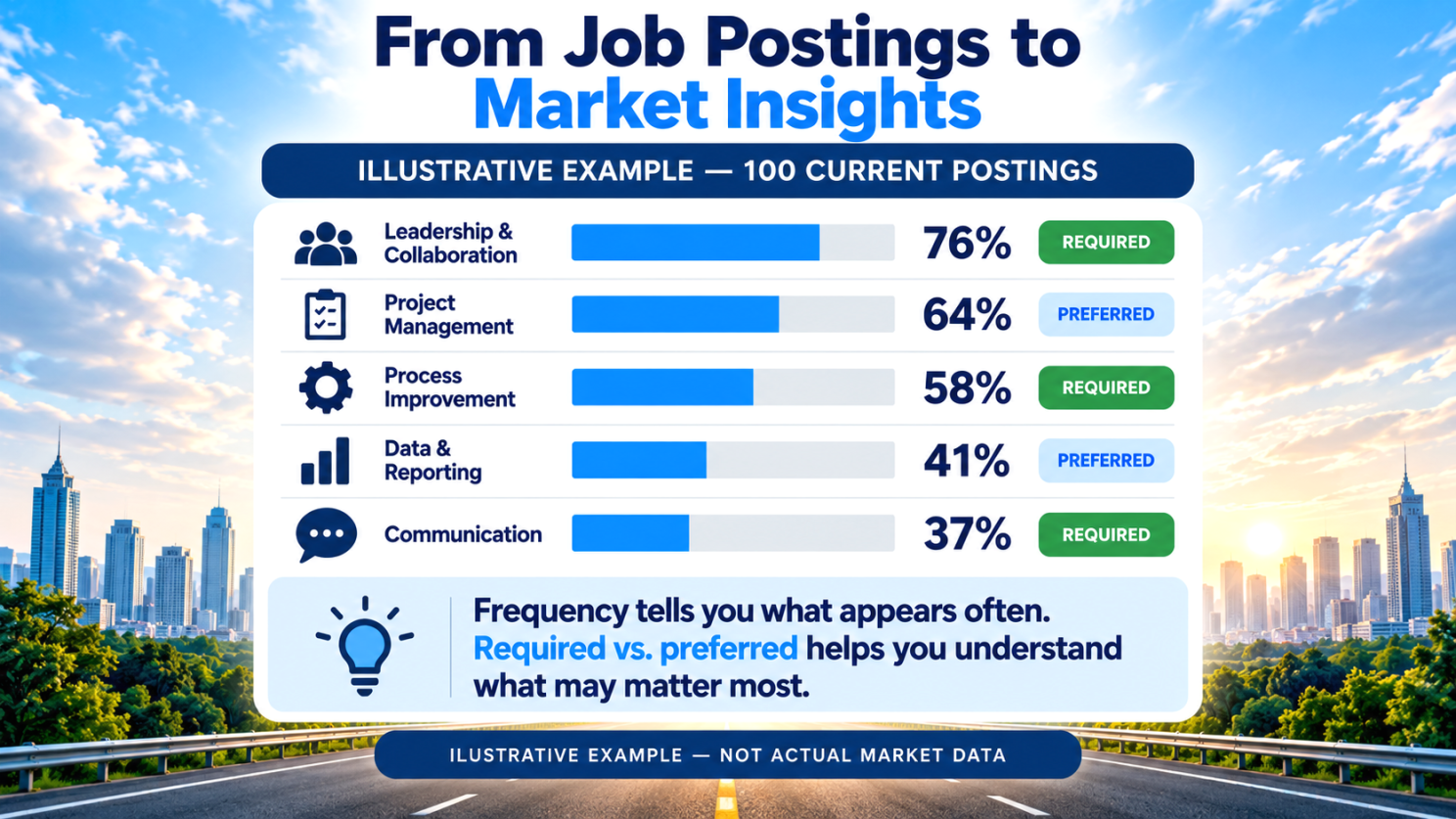
Frequency tells you something. It doesn't tell you everything.
A requirement that appears frequently is worth noticing. But frequency alone does not tell you how important that requirement is. A capability appearing in 70% of postings but usually described as preferred is a different signal from one appearing in 45% but consistently described as required.
Look at several dimensions together: frequency, strength, relevance and evidence. Requirements can also differ meaningfully by seniority, industry, location or work arrangement.
3. Compare
Compare the market with yourself.
Take the recurring requirements identified in the market analysis and compare them with what your resume actually demonstrates. Don't ask AI to assume that because you held a particular title, you must have a particular capability. Don't let it invent experience to close a gap.
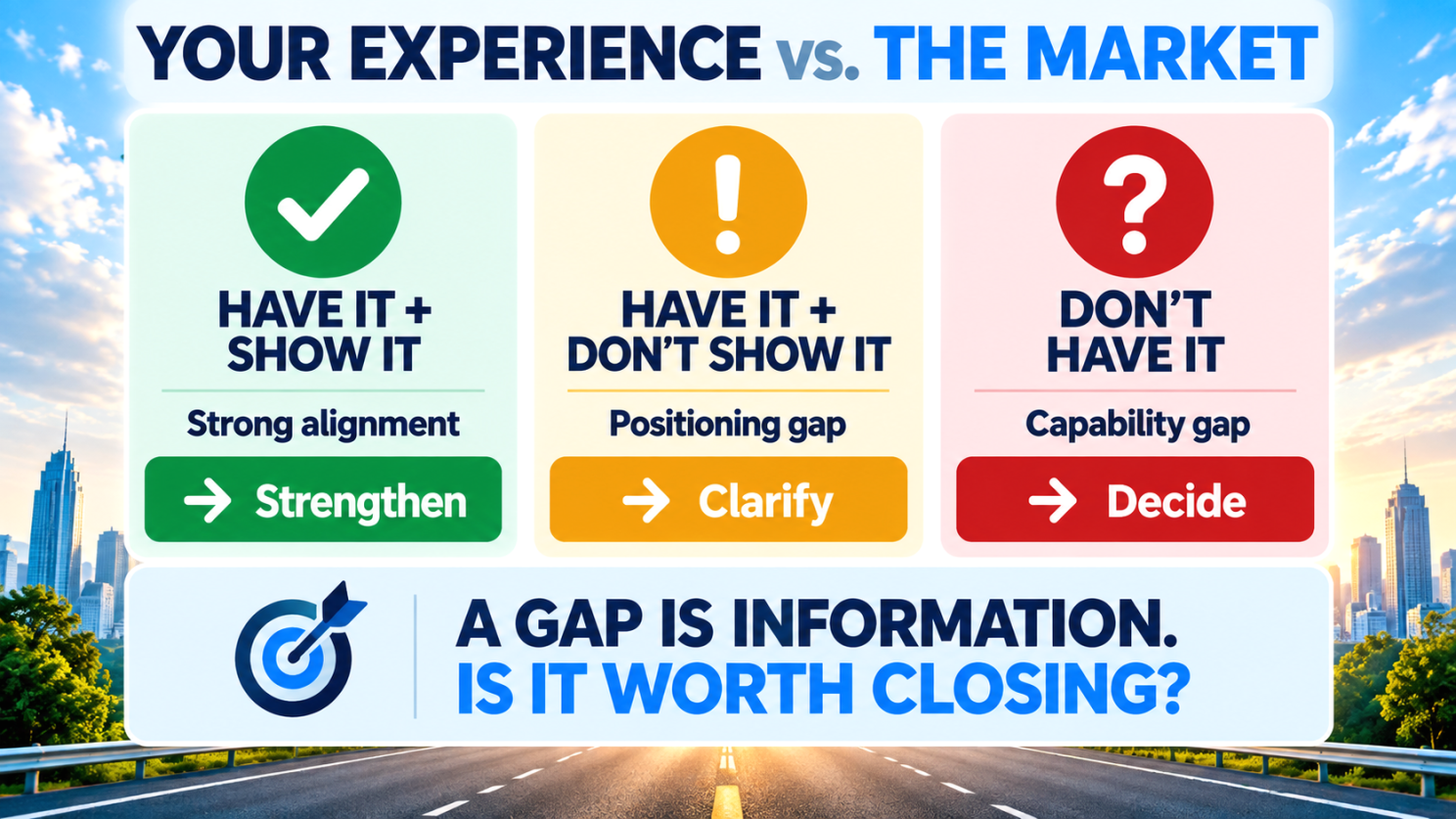
I find it useful to separate the results into three categories: I demonstrate this clearly; I appear to have this experience, but it is underrepresented or unclear; and I do not provide evidence that I have this capability.
The second category may be particularly valuable. Sometimes the problem isn't that we lack what employers want. The problem is that we've made it difficult for them to see that we have it.
Prompt 2 — Compare the Market With Your Experience
Using the market analysis above and my resume, compare my demonstrated experience with the 10 most common market requirements.
Distinguish strong alignment, positioning gaps where experience exists but is unclear, and capability gaps where my materials provide no evidence.
4. Plan
A gap is information. Is it worth closing?
Finding a gap doesn't automatically mean you should fix it. Before deciding on another certification, course or degree, go back to the evidence. Do employers want a certification—or demonstrated experience? Formal education—or working knowledge? A specific credential—or evidence that you can perform the capability?
Prompt 3 — Decide What to Do About the Gaps
Several recurring market requirements do not appear to be supported by my current experience. Analyze those gaps before recommending that I pursue additional education or certification.
Consider how widespread each requirement is, whether it is required or preferred, and whether practical experience, adjacent experience, education, certification, repositioning or no action is the most evidence-supported response.
The answer might be education or certification. It might be a project that gives you practical experience. It might mean narrowing or changing the jobs you're targeting. Or the evidence may tell you to do nothing. Not every gap deserves to be closed.
5. Position
Now—and only now—change the resume.
Notice the order. We didn't begin by asking AI to rewrite the resume. We studied the market first. We identified recurring requirements. We interpreted what those patterns meant. We compared them with actual experience. Then we decided which gaps mattered.
If employers repeatedly ask for a capability you've genuinely demonstrated, make sure they can see it. That may mean strengthening an accomplishment, clarifying an experience, repositioning existing content or reducing material that is taking attention away from what your target market values most.
Prompt 4 — Align Your Resume
Using the market analysis and my demonstrated experience, recommend changes to my resume that would better communicate my fit with the current market.
Do not invent experience and do not keyword-stuff. Make relevant demonstrated experience easier to recognize.
Your LinkedIn Profile Has Another Job
A resume usually responds to an opportunity. Your LinkedIn profile can begin working before an opportunity ever reaches you.
If the market repeatedly values certain capabilities that you genuinely possess, how easily can someone find evidence of them in your profile? Look beyond the Skills section. Consider your headline, About section, experience descriptions and other visible profile content.
Prompt 5 — Align Your LinkedIn Profile
Compare my LinkedIn profile with the market analysis and my revised resume.
Identify where demonstrated capabilities valued by the market are difficult to discover or inconsistently presented.
From Pursuing Opportunities to Becoming More Discoverable
Applying for jobs still matters. This isn't an argument for stopping the outbound job search and waiting for recruiters to arrive. It's an argument for adding another dimension to it.
There are no guarantees. But there's a meaningful difference between pursuing every opportunity you can find and positioning yourself so the right opportunities have a better chance of finding you.
Then Measure What Happens
This shouldn't be a one-time exercise. Once you've made changes, watch what happens. Are more applications turning into conversations? Are recruiters approaching you about roles that are more relevant? Are positions being surfaced to you becoming closer to your target? When interviews don't progress, is there evidence of a capability or positioning weakness worth reconsidering?
The Bigger Idea
AI can write a resume. It can draft a cover letter. It can summarize a job description. Those uses can save time. But one of the more interesting opportunities is different:
AI shouldn't decide which career you pursue. It shouldn't decide whether you need another degree or certification. It shouldn't decide that every gap needs to be closed. And it certainly shouldn't invent experience you don't have.
Let it organize the evidence. Let it identify the patterns. Let it challenge your assumptions. Then make the decisions yourself.
One posting can tell you about a job. A body of postings can tell you about a market.
And understanding the market may be one of the most useful things AI can help a job seeker do.
From Article to Classroom
Turning the framework into a hands-on learning experience.
This framework also forms the foundation of Read the Job Market with AI: A Hands-On Career Discovery Lab, a proposed community education workshop designed to help participants use current job postings and AI to understand an employment market before making decisions about positioning, applications, education or credentials.
The broader principle is explored in Discovery Before Creation: use AI to investigate evidence, understand the environment and challenge assumptions before asking it to create.