
We introduced service catalogs, formal escalation paths, and service-level agreements. We explained the difference between incidents and requests. We invested in platforms to manage it all.
But our customers—the employees depending on those services—had a much simpler test: Did it become easier to get the help they needed, when they needed it?
Could they reach the right person? Did someone understand what the issue was preventing them from doing? When another IT team became involved, did ownership follow, or did they have to explain everything again?
Those experiences shaped their perception more than the terminology we adopted.
For the organization, the question reached further: Did better support help the business accomplish what it needed to do?
The evolution from help desk to service desk should connect those questions. The employee’s experience is where the service becomes visible. The work that experience enables is where its broader value emerges.
The promise behind the change
For many employees, the help desk had a familiar purpose: contact IT when something went wrong.
That relationship was built through practical, demanding work. Support professionals restored access, recovered files, diagnosed failures, and helped colleagues meet deadlines. Their contribution mattered, even when it became visible primarily during a disruption.
But that visibility also shaped perception. The help desk became associated with broken technology. Success meant getting the immediate issue fixed.
The service desk reflected a broader ambition: a dependable point of contact connecting people to the services they needed, whether reporting a disruption, requesting access, or seeking guidance.
Technical resolution remained essential. The broader promise included understanding impact, coordinating assistance, setting expectations, and learning from demand.
Organizations did not all follow the same path. Some teams called help desks already delivered excellent service management. Some adopted the service desk name without substantially changing their approach.
The meaningful distinction was whether support became better connected to the work the organization depended on.
Follow the work beyond the ticket
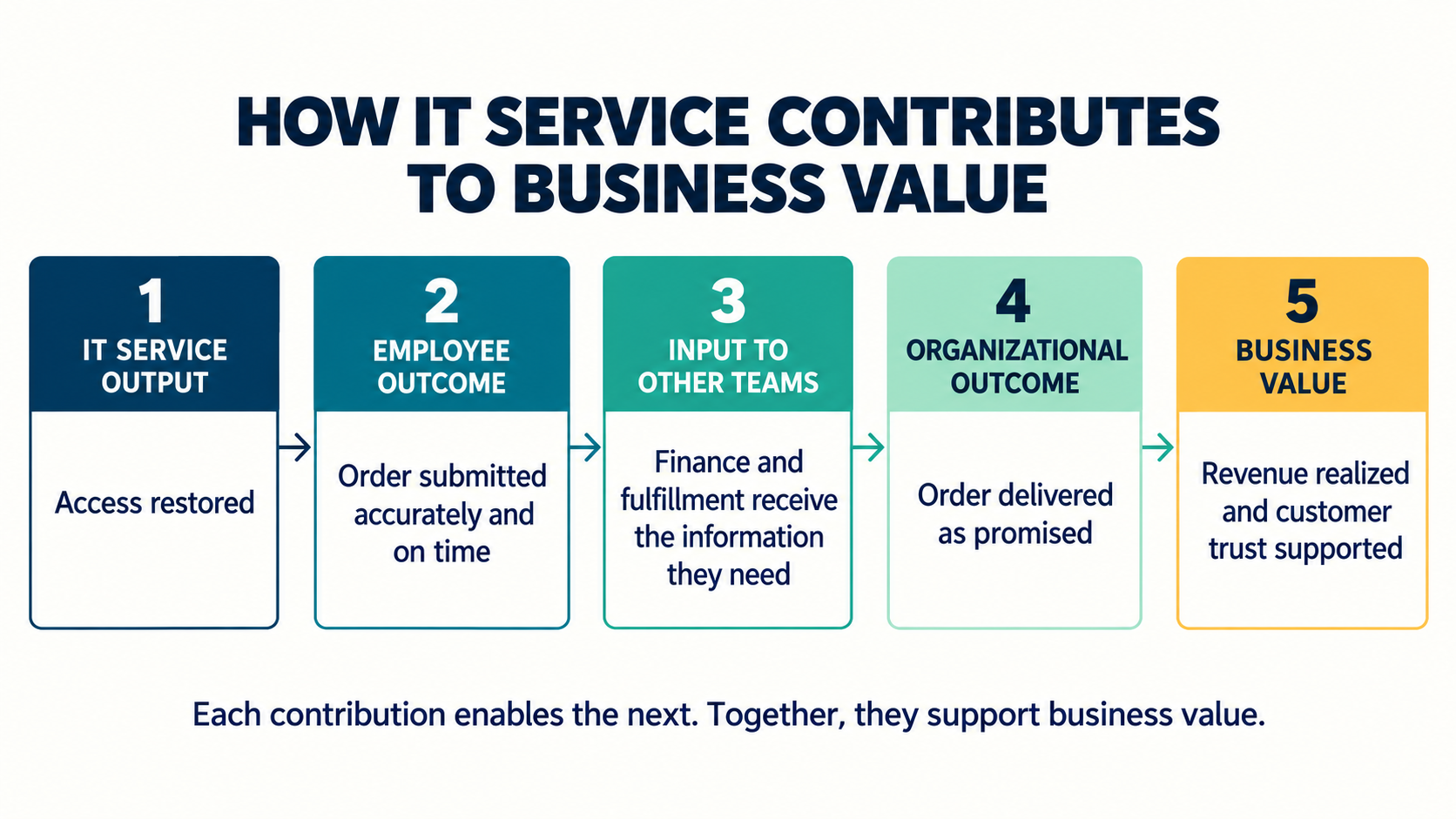
Consider a salesperson who cannot submit a customer order.
Restoring access allows the salesperson to enter it. But entering the order is only one contribution to the outcome. Finance may need to validate the information, inventory must confirm availability, and warehouse or production teams need accurate instructions before fulfillment can proceed.
Each person’s completed work becomes an input to someone else’s work. Technology helps those contributions flow. The customer ultimately experiences whether the organization delivers what it promised.
The issue begins with one employee, but its consequences may extend across departments and reach an external customer.
A delay might be manageable early in the day and become critical as a shipping deadline approaches. A recurring interruption might appear minor in individual tickets while repeatedly disrupting the same business process.
Understanding that impact helps us decide how urgently to respond, whom to involve, and where improvement deserves investment.
A ticket captures the immediate need. Service management follows its consequences through the business.
Two views of the same service
I encountered the importance of that distinction while leading IT and Operations and managing external service providers.
In provider reviews, we discussed response times, resolution targets, and contractual commitments. In conversations with employees, I heard about the work they were trying to complete and the difficulties getting there.
A provider could meet its commitments while employees remained frustrated and business problems remained unresolved.
I was accountable for understanding both perspectives.
The measures could be accurate while leaving important questions unanswered. Had the employee resumed the task? Was a workaround adding effort elsewhere? Was another team waiting on the result? Would the same issue return during the next business cycle?
Meeting an agreed target provided evidence about performance. Assessing the service required understanding what that performance enabled.
That experience reinforced a practical leadership responsibility: keep provider commitments, internal responsibilities, and business expectations aligned—and act when they diverge.
Employees experience our handoffs
Employee onboarding makes this responsibility tangible.
IT can create the account, assign the license, configure the laptop, and establish authentication. Every assigned task may be completed correctly. Yet if access to a critical business application is waiting on an approval nobody owns, the new employee still cannot perform the expected work.
The consequences extend beyond that employee. A manager must rearrange assignments. Colleagues absorb work or spend time finding alternatives. The organization has provided equipment without achieving the readiness those investments were intended to enable.
The employee experiences one onboarding service. Delivering it requires coordinated responsibilities across HR, the hiring manager, IT, application owners, and sometimes external providers.
The service desk can coordinate assistance, but it needs clear ownership, decision rights, and escalation authority behind it.
Who recognizes that the overall outcome remains incomplete? Who contacts the approval owner? Who acts if progress stalls? Who keeps the employee and manager informed?
When those responsibilities are unclear, the person seeking help becomes the coordinator.
This is where ITSM and ITIL thinking becomes practical. Distinguishing incidents, requests, problems, and changes helps us manage different types of work. Bringing those practices together helps us deliver a coherent service.
The organizational chart divides responsibilities. Service management must connect them.
Measure what the service enables
Our measures should help us understand whether that coordination works.
Response times, resolution times, and ticket volumes remain useful. They reveal demand, workload, and performance against agreed expectations.
Their meaning becomes clearer when we examine the intended outcome.
For the salesperson, was order processing restored in time for fulfillment? For the new employee, could the person perform the work the manager expected? Did the resolution remove the obstacle or move it elsewhere?
The service desk does not need to calculate a financial return for every interaction. It does need enough context to distinguish an inconvenience from a disruption with wider consequences.
That context improves prioritization. A frequently reported issue may warrant attention because it affects many people. A less frequent issue may deserve higher priority because it interrupts a critical process.
Useful measurement helps leaders understand what operational activity accomplished and where further action is needed.
Otherwise, we risk optimizing the support workflow while leaving the work it supports unnecessarily difficult.
Improvement must reach beyond the desk
Following those consequences reveals why the service desk cannot carry service improvement alone.
It can explain a policy clearly and still be supporting a confusing policy. It can handle an incident professionally and still be supporting an unreliable application.
Support professionals need the skills and resources to help people through those situations. They also need a dependable route for turning repeated friction into action.
If order processing fails repeatedly, an application owner may need to address a defect or integration dependency. If new employees routinely wait for access, HR, business managers, and application owners may need to redesign approvals.
The service desk contributes evidence and coordination. Leadership must ensure that evidence reaches people with the responsibility and authority to act.
Each resolution helps someone move forward. Effective improvement reduces the likelihood that others will encounter the same obstacle.
Over time, those improvements protect capacity, strengthen reliability, and help the organization deliver on its commitments.
Apply enough discipline to protect the outcome
Making support dependable requires structure. The appropriate amount depends on the work and its consequences.
A routine request may need a clear approval route, an expected completion time, and someone responsible for exceptions. A disruption affecting a critical business process may require coordinated decisions, defined communications, and a tested recovery approach.
Risk, complexity, dependencies, and recoverability should inform the discipline we apply.
Every additional field, approval, or report should contribute something useful: a better decision, clearer accountability, reduced risk, or more dependable delivery.
These are themes I explore in my upcoming book, Minimum Effective Discipline: A Practical Guide to Right-Sized IT Service Management. Its focus is preserving the ownership, judgment, and rigor that services need while simplifying the mechanisms around them.
Keep what matters. Simplify the rest.
For the service desk, that means applying enough discipline to support dependable work and the business outcomes it enables.
Make the evolution matter
Employees notice when they explain an issue once. When updates arrive before they have to chase them. When someone stays engaged across teams. When a recurring disruption finally stops recurring.
Those experiences change their perception of IT support.
Their work then carries the value forward: an order reaches fulfillment, a new colleague becomes productive, a manager receives reliable information, or a customer commitment is met.
That is the progression leaders need to follow—from the support provided, to the work enabled, to the outcomes achieved.
If we want the service desk to be understood differently, we must make that progression part of how we lead it. Clear ownership, aligned providers, meaningful measures, and sustained improvement give the name substance.
We can rename the desk in an afternoon. We earn a different perception when the organization can depend on the work it enables.