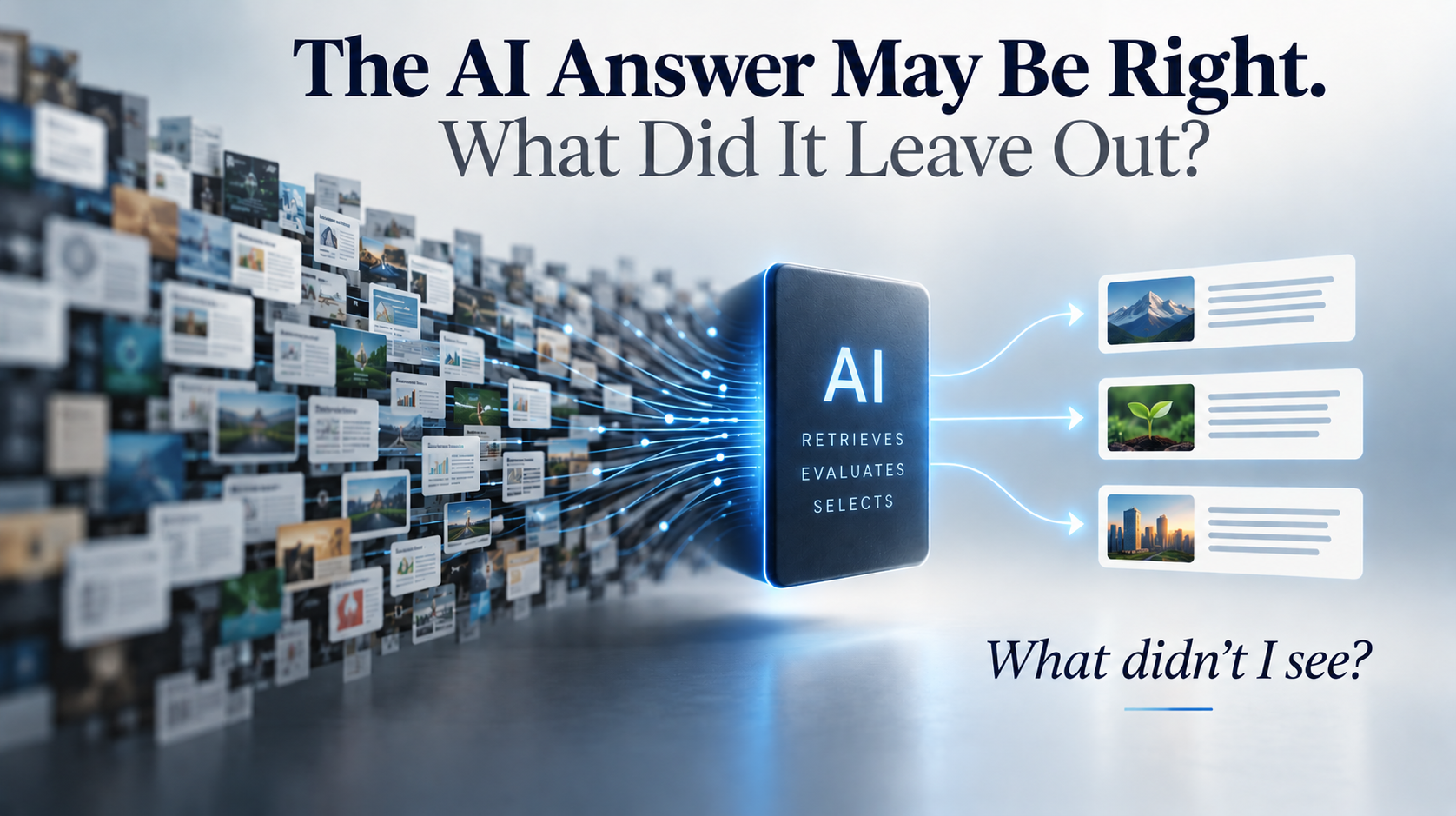
AI can review more information in seconds than I could reasonably review in hours. That is one of its greatest advantages.
But I have started wondering about the other side of that advantage.
If AI reviews 100 possibilities and gives me three, what happened to the other 97?
I arrived at that question while thinking about something seemingly unrelated: SEO.
For years, businesses have worked to improve where they appear in Google, Bing, and other search results. Search engine optimization became part of doing business online. If people could not find you, it did not matter much how good your website was.
Now we have GEO, or generative engine optimization. The terminology is newer, but the business concern is familiar. Companies want their information to be found, understood, and included when someone asks an AI tool a question.
The more I thought about that change, the less interested I became in SEO or GEO.
I became more interested in what is happening to the person asking the question.
We Used to See the Choices
Search engines have never been neutral catalogs of everything on the internet. They rank and filter results. SEO exists because those decisions matter.
But there is something about the traditional search experience that is easy to overlook.
We could see the choices.
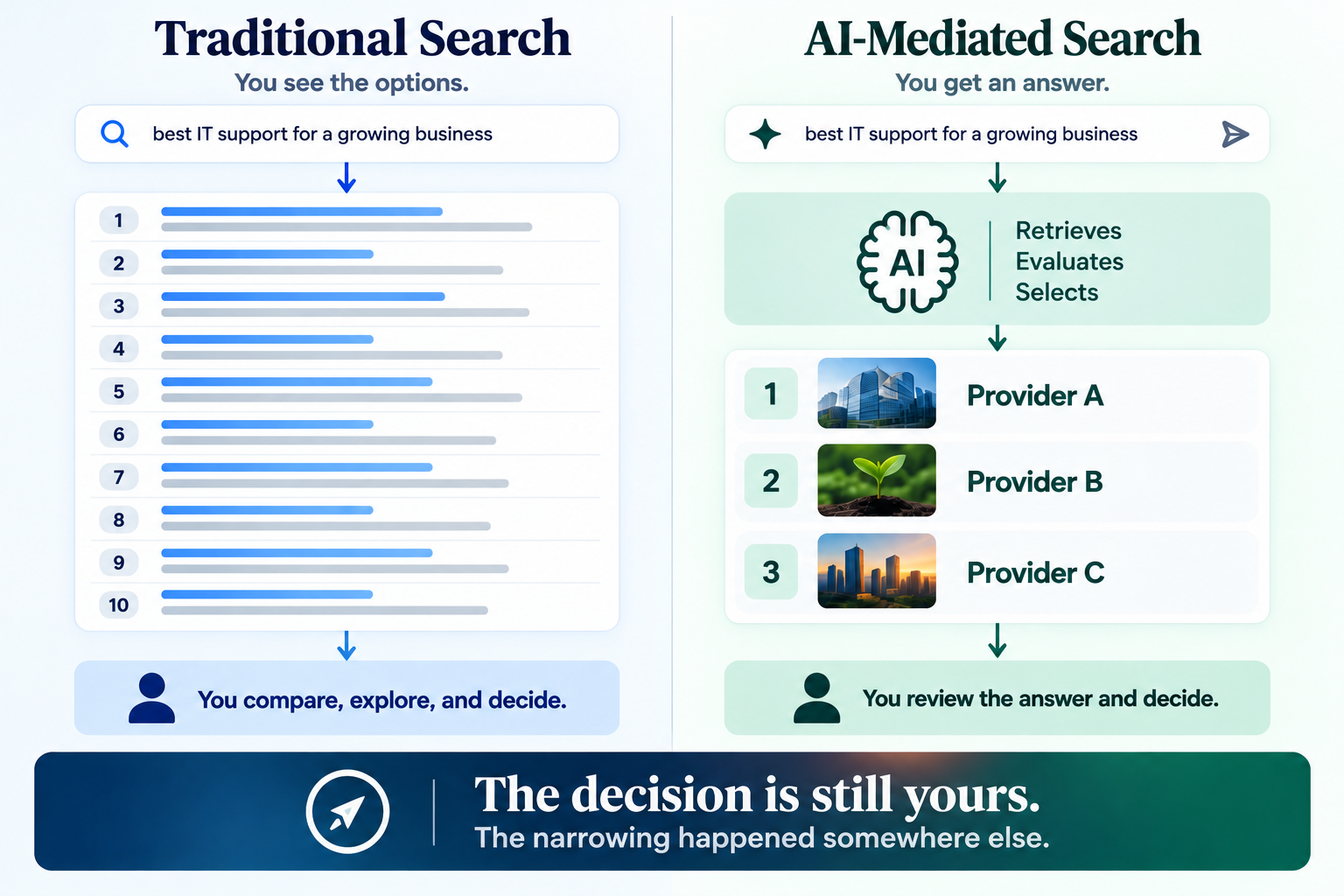
Search for a technology provider and you might get ten results on the first page. You could open the first one, skip it, compare three others, change the search, or keep looking.
The search engine influenced what you saw, but you still participated in narrowing the choices.
Now ask an AI assistant the same question.
Instead of ten links, you may receive an answer assembled from information the system has retrieved and evaluated. It may include several sources or recommendations.
That can be much more useful than opening ten browser tabs.
But what didn't make it into the answer?
The Answer May Be Right
That question is not an accusation that the AI got something wrong.
Suppose I ask:
My 100-person company has outgrown the way we manage technology. What should we change?
There are a lot of possible answers. Hire internal leadership. Change the MSP. Add fractional leadership. Restructure responsibilities. Invest in automation. Perhaps the real problem is something else entirely.
An AI system can review more information about those possibilities in seconds than I could reasonably read myself.
Maybe it gives me an excellent answer.
What I don't know is how it got there.
Which alternatives did it consider? Which sources did it find? Which did it reject? Why did one possibility make the answer while another did not?
That distinction matters because there is evidence that AI recommendations can affect what people consider. A 2024 study in the Journal of Retailing and Consumer Services examined ChatGPT and AI recommender systems and found that their recommendations influenced consumers' consideration sets and purchase journey. Trust was an important part of that relationship.
Pew Research Center found another change in behavior. In its analysis of Google browsing activity, people clicked a traditional search result in 8% of visits when an AI summary appeared. When there was no AI summary, they clicked a traditional result in 15% of visits. Links inside the AI summaries themselves were clicked in just 1% of visits.
That does not tell us AI is producing worse decisions.
It tells us that the way we reach those decisions is changing.
That Brings Me to Bias
We usually hear "AI bias" and think about biased training data, demographic bias, political bias, or an AI system producing an unfair result.
Those issues matter.
I am using bias here in a more literal sense: the selection process that influences which information makes it through and which does not.
Every search system selects information. An AI system working with retrieved information has to select as well. Some sources will be considered more relevant than others. Some information will be included. Some will not.
The difference may be what the human gets to see.
If a search engine gives me ten links, I know I am looking at alternatives.
If an AI gives me an answer synthesized from many sources, I may not know what alternatives were considered and discarded.
There is an interesting contradiction in that.
AI may consider far more information than I ever could while ultimately showing me fewer alternatives.
Research is beginning to examine exactly that issue. In 2026, Microsoft researchers analyzed more than 200,000 real-world human–ChatGPT interactions. They found that people were using AI to ask a broader range of questions, but for comparable queries that could also be handled by traditional search, AI responses were less diverse than Google search results across the majority of topics.
The researchers described a tension between expanded inquiry and constrained information exposure.
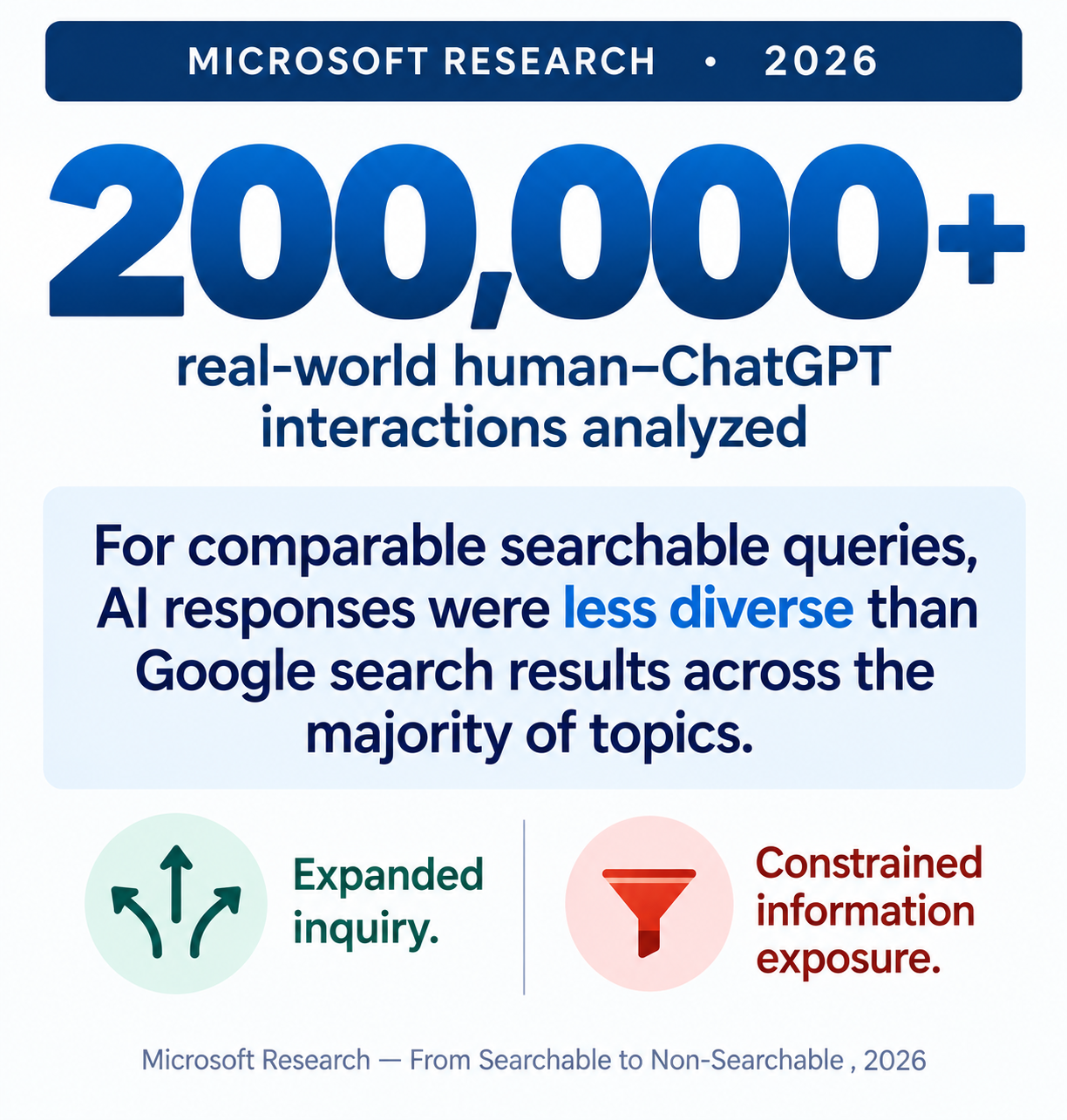
AI can expand the range of questions we ask while potentially narrowing the diversity of information we encounter in the answer.
That caught my attention.
AI can expand what I am capable of asking while potentially narrowing the information I encounter in the answer.
That does not automatically make the selection wrong.
An alternative may have been excluded because it was irrelevant. A source may have ranked poorly. Its information may have been difficult to interpret. Another source may have appeared more authoritative. The AI may have approached the question differently than I would have.
Or one organization may simply have become better at making its information understandable to AI systems than another.
I don't necessarily need to see every option.
But I would like to understand more about how the options I do see got there.
SEO and GEO Look Different From This Side
Businesses are already reacting.
SEO asks how to become visible in search results.
GEO asks how to become visible in generative answers.
Both make sense from the business perspective. If customers increasingly ask AI systems questions, businesses have an obvious interest in making their information accurate, accessible, authoritative, and understandable.
But turn the question around.
Companies are working to influence which information AI systems find, understand, and use.
What does that mean for the person relying on the resulting answer?
The issue is not whether companies should stop optimizing their digital presence. They won't, and they shouldn't.
But the information environment surrounding an AI-generated answer is becoming competitive.
For years, companies competed for position on the search page.
Now they may increasingly compete for inclusion in the answer.
The person asking the question may never see the organizations, products, perspectives, or alternatives that did not make it through that process.
Then Come the Agents
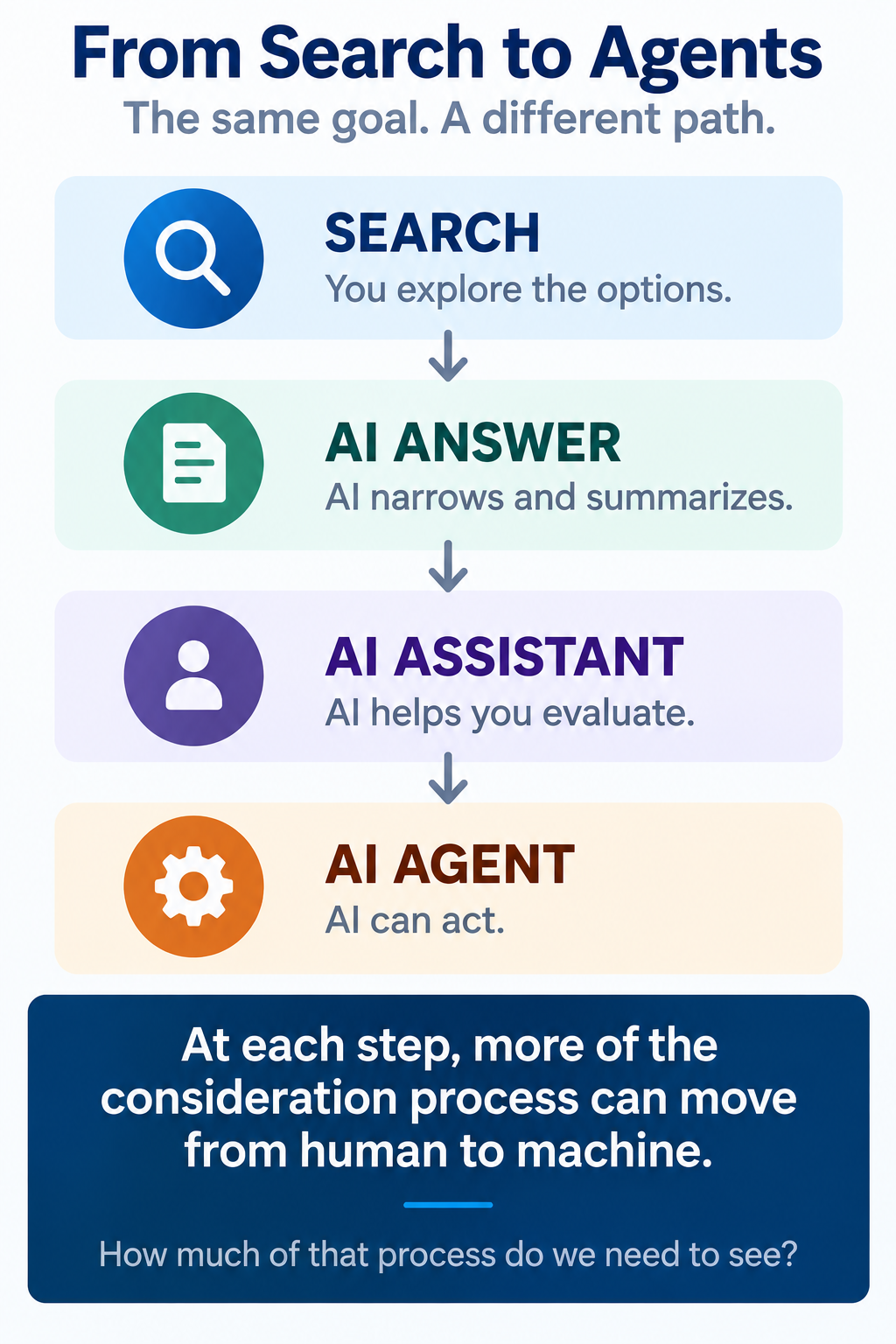
This gets more interesting as AI moves from answering questions to taking action.
If an assistant recommends three choices, I can still decide what to do with them. If an agent eventually makes or executes more of that decision for me, understanding how those three choices were selected becomes considerably more important.
This is not just a hypothetical progression.
In July 2026, Microsoft researchers described the evolution of digital search as a shift from a human-driven process of discovery toward agent-mediated delegated decision-making. In the traditional model, people evaluate ranked links and make decisions outside the search interface. In the emerging model, agents can interpret intentions and return recommendations or potentially execute decisions.
The researchers specifically identify transparency, information access, trust, competition, and how options are surfaced as important questions in that transition.
Those questions become more important as the consequences increase.
Picking a restaurant is one thing.
Selecting a technology provider, choosing a college, evaluating a major purchase, or making a significant business decision is something else.
If an agent evaluates 100 possibilities and recommends three, I may be very happy that I did not have to evaluate the other 97 myself.
That is part of the value.
I would still like to understand something about why those three survived the process.
Maybe the Question Is Changing
I still think SEO matters. GEO matters too.
But neither turned out to be the most interesting question for me.
The more AI helps us work through information, the more we may need to understand how that information was narrowed before it reached us.
There is enormous value in having technology help us work through more information than we could possibly evaluate ourselves. I use that capability regularly.
But there is a difference between delegating the work of reviewing information and unknowingly delegating the decision about which information deserves consideration.
We have spent a lot of time asking whether AI gives us accurate answers.
I think there is another question worth asking.
What didn't I see?
References
Journal of Retailing and Consumer Services — “A comparative study on the effect of ChatGPT recommendation and AI recommender systems on the formation of a consideration set.” Volume 78, May 2024.
Pew Research Center — “Google users are less likely to click on links when an AI summary appears in the results.” July 22, 2025.
Microsoft Research — “From Searchable to Non-Searchable: Generative AI and Information Diversity in Online Information Seeking.” 2026.
Microsoft Research — “The Evolution of Digital Search: From Blue Links to Delegated Decision-Making.” July 2026.